Table Of Content
When participants in a treatment condition take a pill, for example, then those in a placebo control condition would take an identical-looking pill that lacks the active ingredient in the treatment (a “sugar pill”). In research on psychotherapy effectiveness, the placebo might involve going to a psychotherapist and talking in an unstructured way about one’s problems. This is what is shown by a comparison of the two outer bars in Figure 6.2 “Hypothetical Results From a Study Including Treatment, No-Treatment, and Placebo Conditions”. The appropriate statistical test for a within-subjects design depends on the specific research question and the type of data being collected.
Confounding Variables in Psychology Research - Verywell Mind
Confounding Variables in Psychology Research.
Posted: Fri, 15 Dec 2023 08:00:00 GMT [source]
Degree Type
With three conditions (A, B, C), there would be six different orders (ABC, ACB, BAC, BCA, CAB, and CBA), so some participants would be tested in each of the six orders. With four conditions, there would be 24 different orders; with five conditions there would be 120 possible orders. In a 2x2 design, researchers examine how two independent variables with two different levels impact a single dependent variable. For example, imagine a study where researchers wanted to see how the type and duration of therapy influence treatment outcomes. As seen above, sometimes your independent variables will dictate the experimental design.
Simultaneous Within-Subjects Designs
Participants in all conditions have the same mean IQ, same socioeconomic status, same number of siblings, and so on—because they are the very same people. However, not all experiments can use a within-subjects design nor would it be desirable to do so. A factorial design is a type of experimental design that can look at the effects of two or more independent variables. The primary way that researchers accomplish this kind of control of extraneous variables across conditions is called random assignment, which means using a random process to decide which participants are tested in which conditions. Random sampling is a method for selecting a sample from a population, and it is rarely used in psychological research.
Choosing from between-subjects and within-subjects designs
How can I analysis a vignette experiment followed a between-subjects design, two-level (unethical consumption vs ... - ResearchGate
How can I analysis a vignette experiment followed a between-subjects design, two-level (unethical consumption vs ....
Posted: Sun, 10 May 2020 07:00:00 GMT [source]
Because individual variation is removed, this study design has little room for error, and researchers can easily detect differences among treatments. Individual participants bring in to the test their own history, background knowledge, and context. One may be tired after a long night of partying, another one may be bored, yet another one may have received a great news just before the study and be happy. If the same participant interacts with all levels of a variable, she will affect them in the same way. The happy person will be happy on both sites, the tired one will be tired on both.
Because the same participants are used in all conditions, each participant serves as their own control. Researchers can control for order effects by counterbalancing the order in which the different levels of the independent variable are presented to participants. The within-subjects design allows for higher statistical power and requires fewer participants, but it is vulnerable to carryover and order effects, which can compromise the internal validity of the study.
Removes effects of individual differences between conditions
The within-subjects design has advantages and disadvantages, which can affect the validity and reliability of the results. One of the simplest within subject designs is opinion - watch any formalized debate and you will see the process. The chairperson will take a vote before the debate, to establish a baseline opinion, and will ask the audience to vote again at the end. The team that gained the most votes obviously managed to sway opinion in the same subjects much better, so can be announced as the winner. Randomisation and counterbalancing of the order of conditions can help reduce carryover effects. To assess changes in perception, you compare differences in survey responses over time within subjects.
This prevents the effects of earlier treatments from spilling over onto later ones. Other unrelated questions are also asked to make sure participants don’t guess the aim of the study. To test the effects of messaging styles on generosity, you compare the willingness to donate across conditions within subjects. This means that researchers must choose between the two approaches based on their relative merits for the particular situation.
Carryover effects
With between-subject design, this transfer of knowledge is not an issue — participants are never exposed to several levels of the same independent variable. In a within-subjects design, each participant experiences all conditions, and researchers test the same participants repeatedly for differences between conditions. In contrast, there are no variations in individual differences between conditions in a within-subjects design because the same individuals participate in all conditions. In a within-subjects design, all participants in the sample are exposed to the same treatments. The goal is to measure changes over time or changes resulting from different treatments for outcomes such as attitudes, learning, or performance.
It can also be a good way to examine situations in real-world settings, such as to assess the effectiveness of educational programs. In a between-subjects design, one group of participants would do yoga and take a memory test. Since the same individuals participate in all conditions, there will be no effects from variations in individual differences between conditions. Within-subjects studies are typically used for longitudinal studies, as researchers can assess changes within the same group of subjects over an extended period of time. Counterbalancing can be a more convenient option for researchers, as every possible order in which the conditions are presented occurs equally often.
Consider an experiment on the effect of a defendant’s physical attractiveness on judgments of his guilt. Again, in a between-subjects experiment, one group of participants would be shown an attractive defendant and asked to judge his guilt, and another group of participants would be shown an unattractive defendant and asked to judge his guilt. In a within-subjects experiment, however, the same group of participants would judge the guilt of both an attractive and an unattractive defendant. A 2×2 within-subjects design is one in which there are two independent variables each having two different levels.
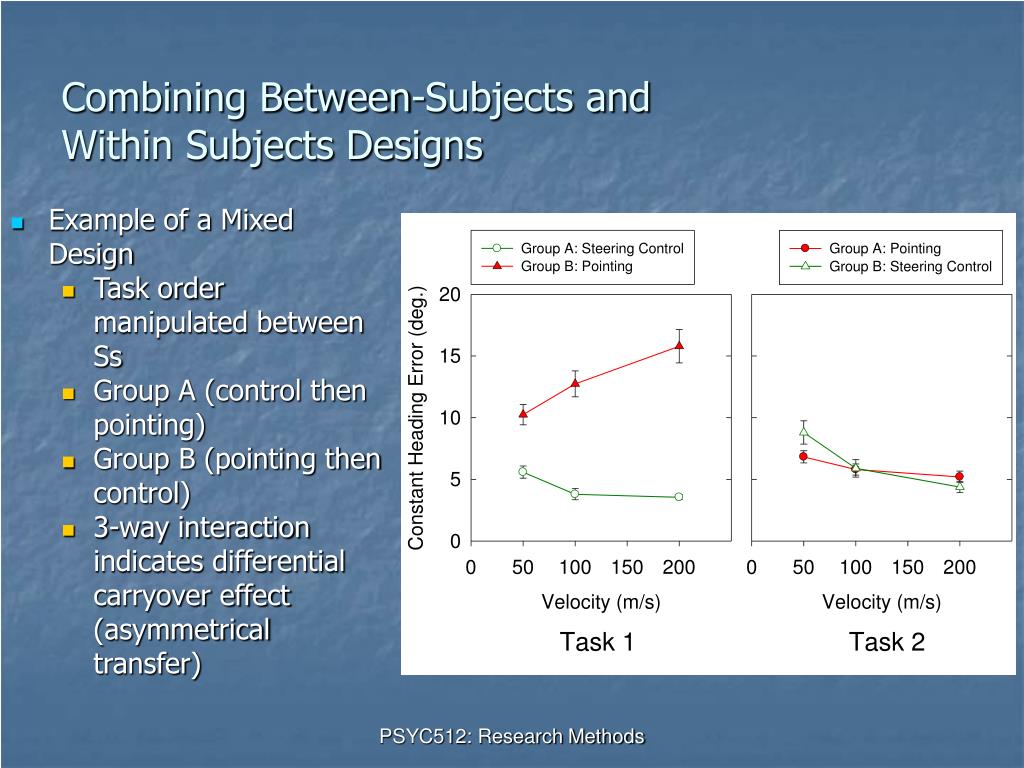
In a mixed factorial design, one variable is altered between subjects and another is altered within subjects. In the realm of research, choosing the right methodology is pivotal for obtaining meaningful results. The within-subject design is one such methodology where participants are exposed to all experimental conditions, allowing for direct comparisons of their responses. Within-subjects design can be useful in experimental research, especially when there is a limited sample size or individual differences between participants must be controlled.


No comments:
Post a Comment